A page per satellite office
Real days open, the attending orthodontist, parking and entrance notes, and its own Dentist schema.
Service file
Orthodontic patients and parents research for weeks before they call, compare two or three practices, and often start at a satellite office rather than the main one. The site has to hold up across that whole span: information good enough to be read twice, a page for every satellite so the nearest one is findable, and a consultation request that reaches the office the patient actually picked. We build the structure for that, and we leave every clinical judgement to your orthodontists.
What it costs
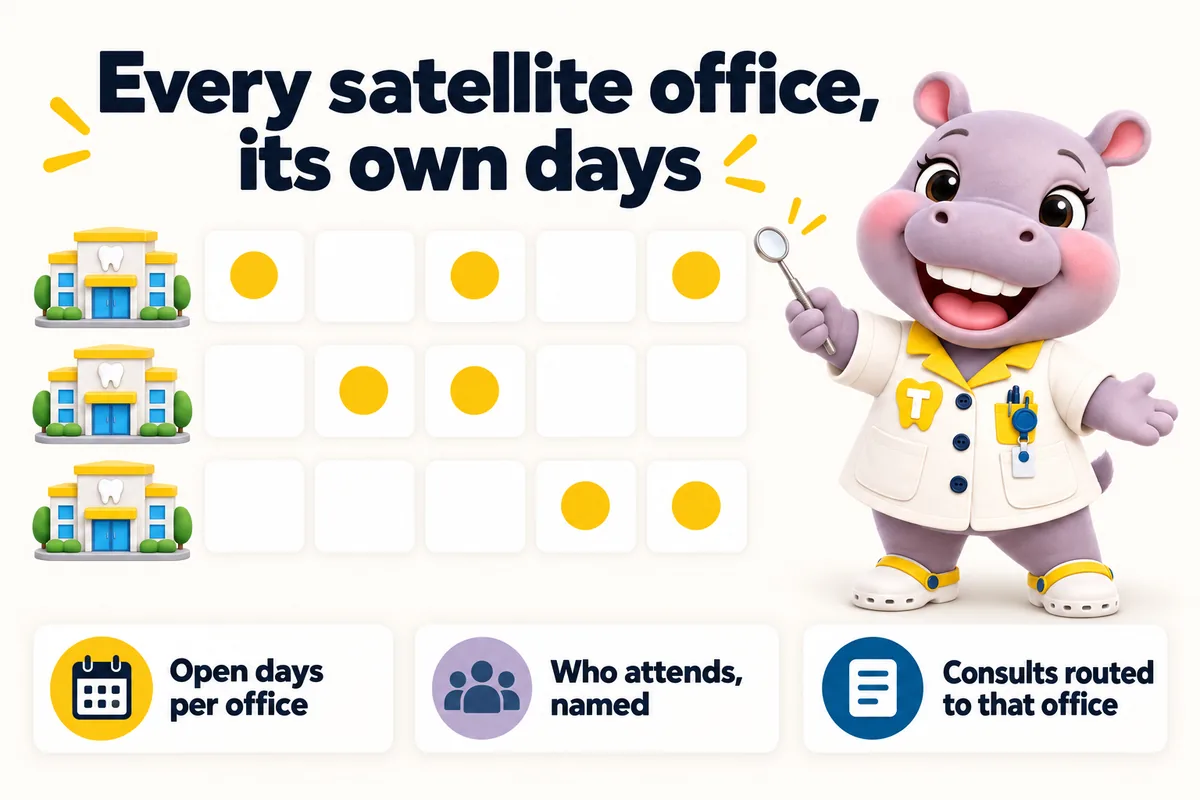
Orthodontic groups typically run one or two main practices and several satellite offices open a few days a week, and those satellites are where growth is. A satellite needs a page of its own with its real days, the orthodontist who attends and its own booking route, not a line on a locations page. It also needs to be honest about frequency, because a parent who drives to a closed office does not come back. We hold days-open per office and surface them in the finder, so a search for a town returns the satellite with the days it is actually open.
Aligners and braces are compared endlessly before anyone books, usually by a parent with tabs open. The pages that work explain what each approach involves, what the appointment rhythm looks like, what to ask at a consultation and how payment plans generally work at your practice, all as general information rather than a recommendation. We do not write which treatment a reader should choose, publish success rates, or present before-and-after galleries as results. Your orthodontists make the clinical case at the consultation, which is where it belongs and where it actually persuades.
An adult aligner patient and a parent booking for a twelve-year-old want different things from the same practice, and forcing them through identical pages serves neither. We separate the paths: adult treatment content that speaks to appearance, appointment timing and work schedules, and a family path that speaks to school hours, sibling appointments and what happens at a first visit. Both routes end at the same consultation request, and both carry the office, the orthodontist and the treatment interest so the front desk knows who is calling and why before they dial.
Orthodontic front desks handle a lot of preliminary conversation, and most of it is information the website could have collected. Our consultation request carries the office, the orthodontist where the patient picked one, the treatment interest, whether the patient is an adult or a child, and the preferred times, delivered into that office's practice management system or your group CRM. It does not collect clinical detail, because that belongs in your systems and in the consultation rather than on a marketing website.
Symptoms
Who it is for
Orthodontic groups with satellite offices, rotating orthodontists and a long consultation decision.
Deliverables
Real days open, the attending orthodontist, parking and entrance notes, and its own Dentist schema.
Service plus town to the nearest office that is actually open for it, with the days it attends.
Two routes through the same practice, both ending at a consultation request that says who is asking.
Aligners and braces explained, with cited sources, without recommending a treatment or claiming an outcome.
Office, orthodontist, treatment interest, adult or child and preferred times, routed to the right front desk.
How financing usually works at your practice, written as information rather than a quote or a promise.
Thirty minutes
We open a site built for a group like yours, walk the pages a patient would, and tell you which plan fits. Plans from $137 a month; the $797 build fee is invoiced after launch.
How the work is done
The same four steps for every service. The only thing paid before launch is the first month.
Pick a plan and pay the first month. That is the whole commitment; the $797 build fee waits until your site is live.
Thirty minutes with your operations lead: offices, providers, services, brand, where each office's requests should go, and hub or one site per location.
We design the site, write the pages, configure the finder for each office and connect each front desk. You review, we revise.
Your site goes live in 7, 10 or 15 days depending on the plan. Only then is the $797 build fee invoiced. Weekly updates start the same week.
Timeline
Counted from the onboarding call, not from purchase. Revisions after launch are completed within 2 to 5 working days.
Cost
We usually suggest Operatory Suite for orthodontic groups, for the AI receptionist and SMS replies that answer consultation questions after hours; usage is billed at cost.
What's in each plan
What each feature does, the everyday problem it removes, what you have to do (usually nothing), and which plan carries it.
Out of scope
So nobody is surprised after ordering. Each of these is a deliberate line, not an upsell waiting to happen.
We do not write treatment recommendations, success rates, outcome claims or before-and-after captions. Your clinicians own every statement about care.
Request forms ask for a name, contact details, the office, the service and a preferred time. Medical history, insurance IDs and consent forms stay in your own intake system, never on the website.
We build pages that are fast and relevant enough to be good landing pages for your ads. Running and bidding on the campaigns themselves stays with you or your ads partner.
We route requests into the system or CRM each office already uses, by API, Zapier or Make. We do not sell, host or administer the practice software itself.
We use the office and team photos you own and have consent to publish, sized for their slots. Where you have none yet we use neutral, non-clinical images until yours arrive.
There are none. One fee covers every office in the group; extra revisions beyond 5 a month are a flat $20 each.
Reviews
The idea that visitors could sort themselves before writing seemed obvious only in hindsight. The sender picks the route, which means the best-informed person does the sorting. The morning triage is minutes rather than an hour.
Got Inquiry categories and guided navigation for dental office selection
Existing customers asking about dental office selection had no front door of their own. The two message types arrive under different subjects, so the sorting is done for us. Our inbox is easier to read, and their morning is easier too.
Got Returning-customer contact path for dental office selection
Built in, not bolted on
A dental website carries obligations a brochure site does not. These ship with every plan, written for your practice and reviewed by you before launch.
These pages and practices help you meet common US requirements for a dental practice website. They are not legal advice, and we recommend your own counsel reviews the policies before launch. We are not a dental practice, dental group, dentist or healthcare provider, and we are not a law firm.
A privacy policy and site terms written around what your site actually collects, drafted for your review and your counsel's sign-off. Built with state privacy laws such as the CCPA in California in mind.
Analytics and marketing tags load only after a visitor agrees, and the cookie policy lists what the consent banner controls.
Real contrast ratios, visible focus states, keyboard navigation and alt text, built with the Americans with Disabilities Act (ADA) and WCAG 2.2 AA in mind, plus a statement telling patients how to report a problem.
Request forms are designed not to collect health information. That keeps the website out of your HIPAA scope as far as a website can be, while your intake system handles records.
Where a form or the AI Engine sends texts, consent wording sits next to the phone field, and we file the A2P 10DLC carrier registration for you on plans with the AI Engine.
Service pages and articles say they are general information, not a diagnosis or treatment plan, and send patients to your providers for anything about their own care.
Risk reversal
Each promise is written with its condition in plain sight, so nothing is discovered after the invoice.
The $797 one-time build fee is invoiced after launch, once you have seen the site live and are happy with it.
Condition The first monthly fee is paid up front to start the plan.
Every page we build scores at or above the target on mobile and desktop at launch.
Condition If a page drops below it because of our work, we fix it at no charge and it does not use a revision.
The site starts ranking for local searches in your area within the window.
Condition If it has not, we keep working on it at no charge. We never promise a specific position.
Case studies
No. 07Orthodontics
Day to day with dental office selection, duplicated replies and orphaned messages happened in the same week. Stepping in for an absent colleague meant archaeology through long email chains.
20 working days
No. 12General dentistry
When it comes to dental office selection, the good material existed internally and stayed there. Callers asked sensible questions the site could have answered but never did.
25 working days
No. 13General dentistry
For dental office selection, the team opened every morning to fragments: voicemails, bare emails, half-completed forms. Prioritising them required detective work before any real work.
10 working days
Yes, and it should. Days open, the attending clinician and the booking destination are held per office, and the finder uses them so nobody is sent to an office that is closed that day.
We write general information explaining what each involves, what the appointment rhythm looks like and what to ask at a consultation, with cited sources. We do not recommend a treatment for a reader, and we do not publish success rates or outcome claims.
Photographs of your practice and your team, yes. Treatment before-and-afters presented as results are an outcome claim, and we do not build them into the site. If your clinicians want to publish clinical imagery, that is a decision for them with their own review and their own disclosures.
Every request carries the office, the orthodontist where one was picked, the treatment interest and whether the patient is an adult or a child, and is delivered to that office's practice management system or your group CRM by API, Zapier or Make.
Yes. A referral route can be built with its own page and its own intake, so a referring practice sends what you need without going through the patient consultation form.
Yes, on Operatory Suite and Group. It answers general questions about offices, hours and booking, takes the consultation request and routes it to the right office. It never gives treatment advice.
Yes, as a revision: a promotion page or banner on the relevant service pages, added and removed within the revision turnaround.
Yes. Each satellite has its own page with the days it is open and the orthodontist working there.
A live walk-through of the site you would get, in about 30 minutes. Plans from $137 a month, the $797 build fee invoiced only after launch, domain and hosting included.
Book a demoOr email and a person replies within one working day.
ChairsideWeb uses the cookies below. Necessary cookies keep the site working and cannot be turned off.
Saved on this device only. Press Esc to close.